On March 31, 2026, the Ministry of Science and Technology officially approved the Scheme on “Continuing the Development of Posts and Telecommunications Institute of Technology as an Organization for In-Depth Training and Research in Science, Technology, Innovation, and Digital Transformation for the 2026–2035 Period.” This marks a major turning point, positioning the Institute as a leader in the country’s strategic technological fields.
Vision of Becoming a Next-Generation Tech University
According to Decision No. 1985/QD-BKHCN, Posts and Telecommunications Institute of Technology (PTIT) is oriented to develop into a national leading and globally competitive organization for in-depth training and research. The Scheme’s consistent perspective is to strictly implement the “Triple Helix” model, seamlessly integrating research, training, and technology transfer.
Notably, the Institute will serve as a “sandbox” (testing environment) for novel models, directly translating national development orientations into academic majors and practical applications, thereby creating a rapid feedback loop for policy-making.
Breakthrough Goals Towards 2035
The Scheme sets out specific goals to transform the Institute into a core force within the national science and technology ecosystem:
-
Leading in Artificial Intelligence (AI): Building a national-scale shared AI computing infrastructure center. By 2030, the Institute aims to build an AI server cluster with thousands of GPUs. It will also serve as the backbone for developing a Vietnamese Large Language Model (LLM) tailored for education and culture.
-
Pioneering Emerging Tech Industries: Opening majors and nurturing talent in “hot” fields, including semiconductors, UAVs, autonomous robots, aerospace, low-altitude economy, and digital assets.
-
An Innovation Ecosystem: Developing a national-level innovation center, with the target of incubating at least 30 startups by 2027 and aiming to nurture a “unicorn” enterprise by 2035.
-
A Role Model for Digital University: Becoming a leading provider of digital platforms for the higher education system. The goal is that by 2030, 100% of the Institute’s governance and training activities will be supported by digital platforms.
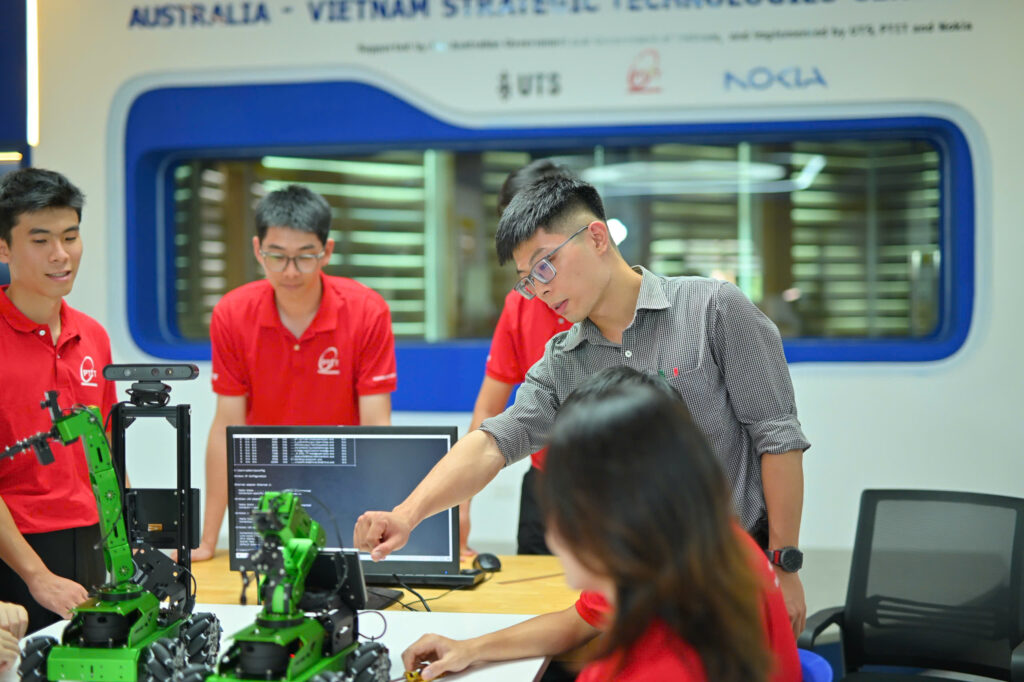
The Institute strives to form regional-standard in-depth research groups and specialized laboratories, maintaining its position among the top educational institutions in Asia for AI.
Emphasis on Commercialization and Intellectual Property
Moving beyond pure research, the Scheme emphasizes boosting the commercialization capacity of intellectual property, considering it a vital pillar for enhancing the practical value of scientific and technological activities at the Posts and Telecommunications Institute of Technology.
The Institute aims to reach 100–120 intellectual property applications per year by 2035, focusing not only on quantity but also on elevating the quality and applicability of inventions and utility solutions. Concurrently, promoting the formation of 30–50 science-technology enterprises and spin-offs will create concrete “outputs” for research activities, helping to bring technology from the lab to the market.
To realize this goal, Posts and Telecommunications Institute of Technology will strengthen cooperation with enterprises, investment funds, and startup support organizations. It will also develop mechanisms to encourage lecturers, scientists, and students to register intellectual property and participate in innovative entrepreneurship.
The target of increasing revenue from technology commercialization to at least 20% by 2030 not only diversifies financial resources but also marks a powerful shift from a traditional university model to an innovative one—where knowledge is transformed into economic value, directly contributing to the growth of businesses and society.
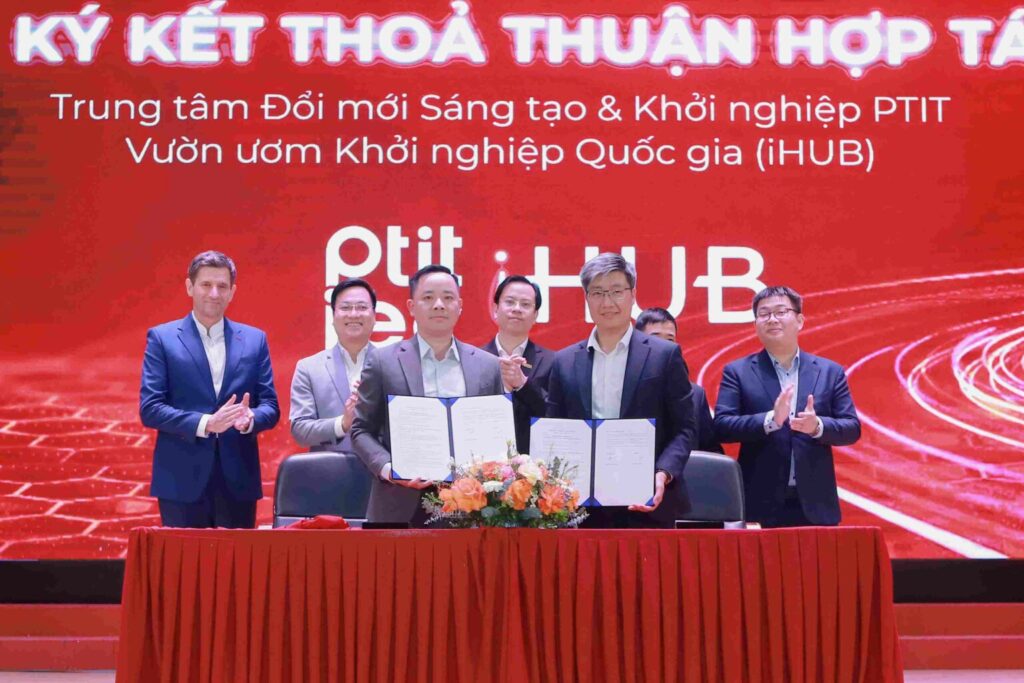
Posts and Telecommunications Institute of Technology, the National Startup Incubator, and the Hanoi Innovation Center announced a strategic partnership to connect and develop the Startup-Innovation Ecosystem in February 2026.
A Global Educational Mission
In addition to serving domestic socio-economic development, Posts and Telecommunications Institute of Technology aims to expand its educational space globally by building a multilingual Massive Open Online Course (MOOC) platform.
This system will not only provide flexible online courses but also personalize learning paths by integrating advanced digital technologies such as AI, learning analytics, and smart learning platforms. Through this, learners can access knowledge anytime and anywhere, catering to diverse groups and needs.
In particular, the model targets specific learner groups, including the overseas Vietnamese community, workers in industrial zones, military personnel, and those unable to attend traditional training programs. This is viewed as a vital solution to broaden access to high-quality education, contributing to promoting lifelong learning and upskilling the workforce in the digital era.
In tandem, the Posts and Telecommunications Institute of Technology will develop short-term training programs, digital credentials, and specialized courses aligned with the practical needs of the global labor market, particularly in emerging technologies and the digital economy.
With the goal of serving 1 million learners by 2030, the open digital university model will not only enhance the quality of the domestic workforce but also spread Vietnamese knowledge worldwide, step by step asserting the Institute’s position in the global digital education ecosystem.

The open digital university model will spread Vietnamese knowledge worldwide.
Contributing to the Formation of National Knowledge Hubs
As Vietnam accelerates its scientific and technological development and digital transformation, building specialized higher education institutions is seen as a key solution for forming internationally competitive knowledge hubs.
The approval of the development Scheme for Posts and Telecommunications Institute of Technology by the Ministry of Science and Technology is therefore significant not only for the Institute itself but also for boosting Vietnam’s innovation ecosystem and digital economy in the coming period.
With this new orientation, the Posts and Telecommunications Institute of Technology is expected to become one of the “locomotives” in training, research, and innovation, contributing to the development of the human resources and technology needed for the sustainable growth of Vietnam’s digital economy.