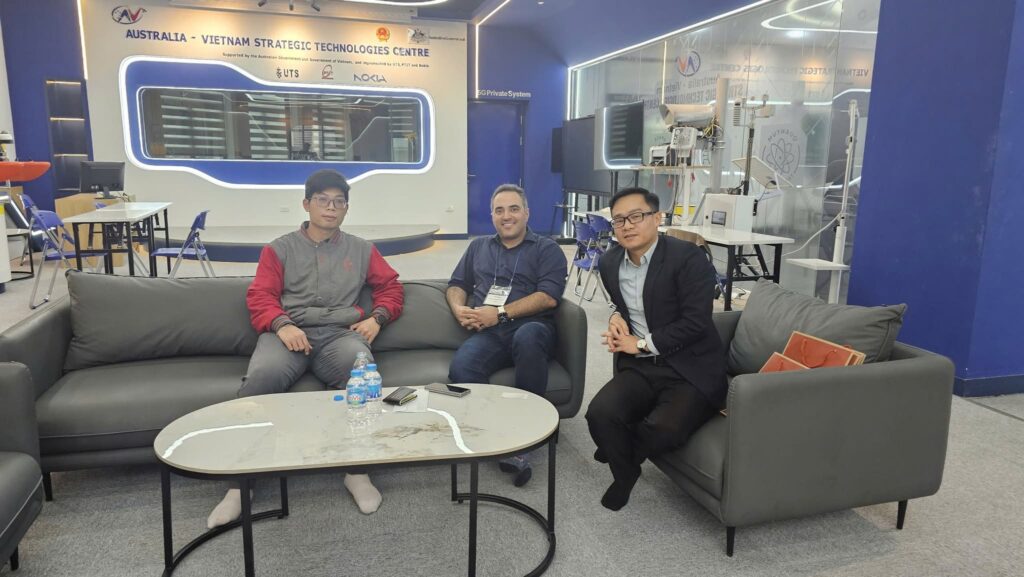
On January 15, Dr. Nguyen Viet Hung, Chief Operating Officer of AVSTC, represented the Center in an academic discussion with A/Prof. Ali Yavari, Director of the 6G Research and Innovation Lab at Swinburne University of Technology (Australia). The meeting served as an important platform for exchanging research ideas and exploring future collaboration opportunities in the emerging field of bioelectromagnetics and next-generation wireless communication technologies.
The discussion focused on the biological effects of electromagnetic waves generated by 5G and future 6G communication systems, an increasingly important research area as wireless technologies continue to evolve toward higher frequencies, greater bandwidth, and denser network deployments. Understanding the interaction between electromagnetic fields and biological systems is essential for ensuring the safe, sustainable, and responsible development of future communication infrastructures.
At the beginning of the meeting, representatives from AVSTC introduced the Center’s organizational structure, research groups, ongoing projects, and strategic development directions. In return, A/Prof. Ali Yavari presented an overview of the 6G Research and Innovation Lab, highlighting its multidisciplinary research activities and state-of-the-art experimental facilities dedicated to investigating the biological impacts of millimeter-wave technologies.
A significant part of the discussion was devoted to several representative research projects currently conducted at the 6G Research and Innovation Lab. These include studies on characterizing structural changes in corneal collagen induced by millimeter-wave radiation using Raman spectroscopy, investigating tissue metabolism under 26 GHz millimeter-wave exposure through Fluorescence Lifetime Imaging Microscopy (FLIM), and analyzing corneal metabolism and cellular stress responses using advanced spectroscopic techniques. These research efforts provide valuable scientific evidence for evaluating the safety of emerging wireless communication technologies and contribute to the development of internationally recognized assessment methodologies.
Beyond sharing ongoing research activities, both parties exchanged views on opportunities for academic collaboration and international student exchanges. One of the key topics was participation in collaborative activities through the BioEM (Bioelectromagnetics Community), an international organization that promotes scientific cooperation among researchers working in bioelectromagnetics and related disciplines. Such initiatives are expected to create valuable opportunities for researchers and students to engage in international academic networks, joint research projects, and knowledge exchange.
Looking ahead, AVSTC and the 6G Research and Innovation Lab expressed a shared interest in establishing long-term collaborative research programs. Future cooperation will focus on investigating the biological impacts of electromagnetic waves generated by next-generation communication systems on living organisms, including humans, animals, and plants.
The collaboration also aims to develop interdisciplinary research that integrates telecommunications engineering, biology, biomedical engineering, and health sciences to address emerging scientific challenges associated with future wireless technologies.
This academic exchange marks an important step toward strengthening international partnerships while fostering interdisciplinary research in one of the most rapidly developing areas of communication technology. Through collaboration with leading international research institutions, AVSTC continues its commitment to advancing scientific innovation, supporting researcher development, and contributing to the safe and sustainable evolution of next-generation wireless communication systems.