Entering the year 2026, Vietnam’s education and training sector (in general) and the higher education sector (in particular) face many significant opportunities, opening up a new phase of development in quality, scale, and international integration.
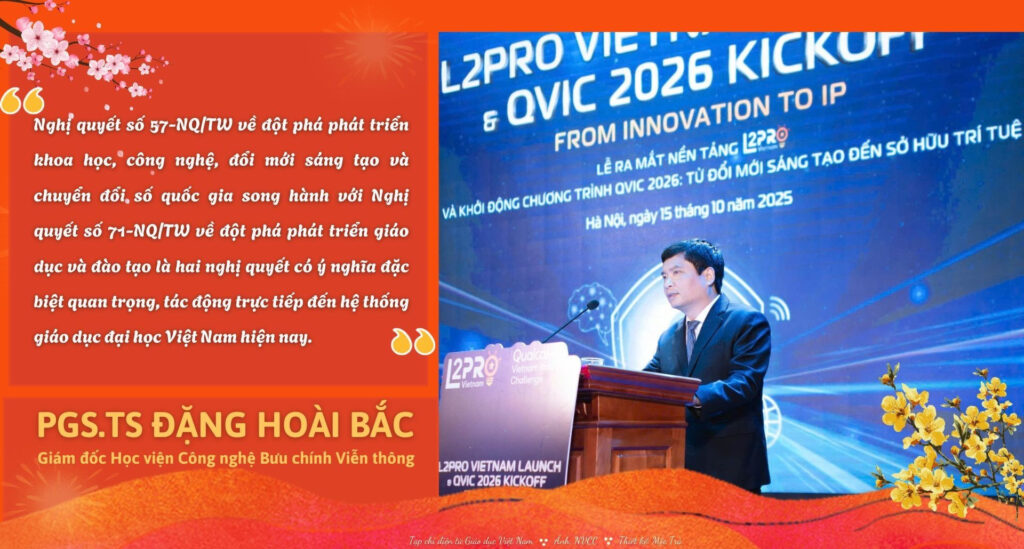
On the occasion of the Lunar New Year of the Horse 2026, Assoc. Prof. Dr. Dang Hoai Bac – President of Posts and Telecommunications Institute of Technology (PTIT) – had an interview with reporters from the Vietnam Educational Electronic Magazine, sharing expectations for the institution’s training and research activities as it stands before a new development phase.
An Urgent Requirement for Universities in the New Context
Reflecting on the prominent milestones of 2025, Assoc. Prof. Dr. Dang Hoai Bac emphasized that over the past year, the Institute continued to achieve many important results. Specifically, the Institute promoted its traditions of solidarity, creativity, proactivity, and decisiveness in implementing tasks, successfully fulfilling its strategic goals for the 2020–2025 period. At the same time, it steadily maintained and enhanced the quality of training, scientific research, international cooperation, and digital transformation.
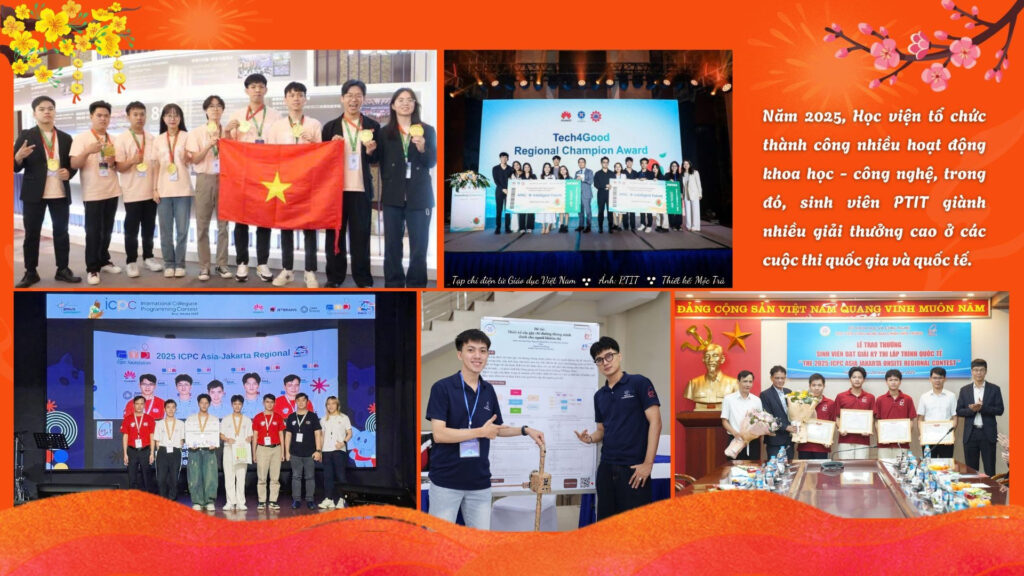
In 2025, the Institute was recognized as one of the 5 national key higher education institutions in engineering and technology. It pioneered the opening of strategic training majors, such as Artificial Intelligence, Internet of Things, and Semiconductor Chip Technology; inaugurated international-standard laboratories; and successfully organized numerous scientific and technological activities, in which PTIT students won many top prizes in national and international competitions. The Institute’s new training programs, technology application models, and digital ecosystem continue to be highly appreciated by society, contributing to the elevation of the university’s brand position.
In addition, Assoc. Prof. Dr. Dang Hoai Bac mentioned: “Resolution No. 57-NQ/TW on breakthroughs in national science, technology, innovation, and digital transformation, alongside Resolution No. 71-NQ/TW on breakthroughs in education and training, are two particularly important resolutions that directly impact the current Vietnamese higher education system.
In this new context, both resolutions place an urgent demand on universities to fundamentally innovate their training methods, shifting from traditional teaching models to modern educational models. In these models, the focus is not only on imparting knowledge but also on developing learners’ creative thinking, self-learning capabilities, practical skills, and adaptability to the digital environment.
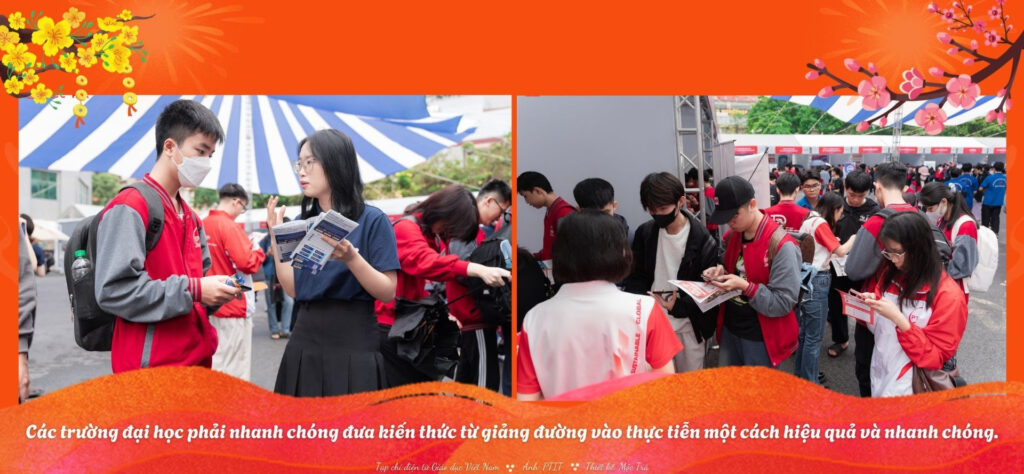
In particular, universities must effectively and rapidly transfer knowledge from the lecture hall into practice…”
.
As one of the 5 key universities in engineering and technology, Posts and Telecommunications Institute of Technology has implemented the spirit of these two resolutions through concrete actions.
Regarding teaching methodologies, Posts and Telecommunications Institute of Technology has accelerated its comprehensive digital transformation, spanning modern university governance to innovative training methods.
Notably, PTIT is using Artificial Intelligence (AI) as a powerful teaching assistant, with the goal of having 100% of the Institute’s courses feature AI teaching assistants by 2027. Learning content is built on advanced curricula and materials from the world’s leading universities, enhancing training quality and narrowing the gap between the educational environment and reality.
Furthermore, Posts and Telecommunications Institute of Technology is piloting a 3.5+1+1 training model, enabling students to progress directly to a master’s degree or obtain a second bachelor’s degree within an optimized timeframe. This reduction in training duration is implemented on a foundation of comprehensive digital transformation and a modern digital learning materials system, offering the best learning experience for students.
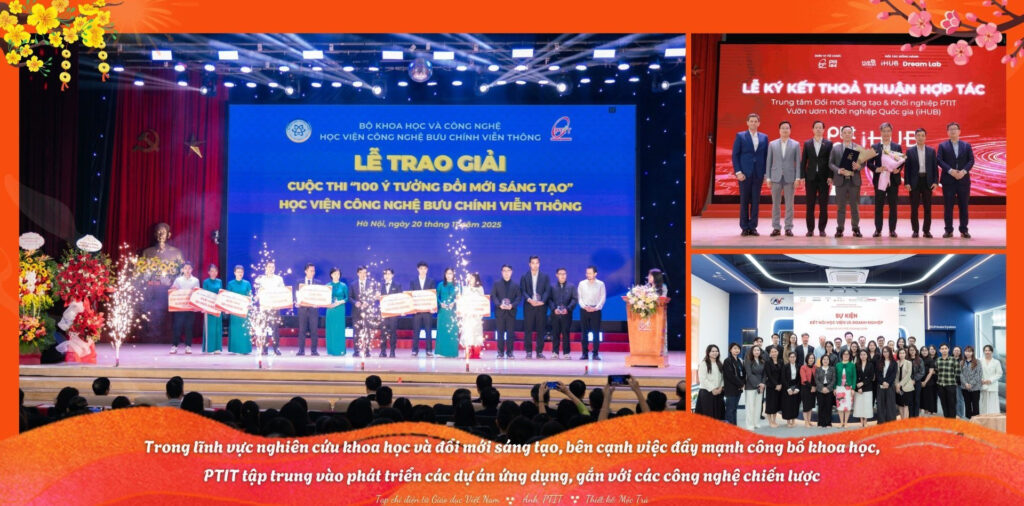
In the field of scientific research and innovation, in addition to boosting scientific publications, the Posts and Telecommunications Institute of Technology focuses on developing application-oriented projects tied to strategic technologies. These include projects to build an AI ecosystem in education—consisting of School AI, Tutor AI, and AI that supports the hearing-impaired in learning—as well as UAV (unmanned aerial vehicle) solutions combined with image processing for environmental and air-quality monitoring. Several in-depth research projects, such as Large Language Models (LLMs), DeepEdu Vietnam in education, IoT chip design for agriculture, and AI assisting the elderly, are being carried out under the “Triple Helix” cooperation model (State – University – Enterprise).
“As a national key higher education institution in the digital technology sector, Posts and Telecommunications Institute of Technology not only pioneers AI training but also proactively utilizes AI to ‘redefine’ the higher education model. Recently, the Institute has actively researched, developed, and deployed AI solutions into teaching, learning, and management practice, step-by-step forming a modern and synchronized digital ecosystem.
Building and developing an AI ecosystem for education not only contributes to innovating training methods toward flexibility and personalizing the learning experience for each student and trainee, but also enhances the teaching efficiency of the faculty. This is a crucial step in the comprehensive digital transformation roadmap toward a smart university model, where technology becomes the core operational foundation.
The Institute’s AI ecosystem for education is shaped as a comprehensive knowledge infrastructure, combining specialized large language models with a rich source of academic data, creating an open learning environment unrestricted by space and time. Learners can receive instant support and personalized content and learning paths, thereby improving absorption efficiency and self-learning capacity. This also serves as a premise to create a borderless educational environment, strengthening connection and knowledge sharing.
In particular, the sub-system ‘AI Teaching Assistant for Programming Courses’ is considered one of the exemplary systems. With its practical goals and values, this system is not merely a technological product, but also demonstrates a concrete, decisive step by the Institute in embedding AI into the depth of its training activities, contributing to raising the quality of digital technology human resources in the new era,” shared Assoc. Prof. Dr. Dang Hoai Bac.
Becoming a Leading Next-Generation Tech University in Innovation and a Model for the Successful Implementation of Both Resolutions
According to the President of Posts and Telecommunications Institute of Technology, the Institute has now formed 30 key laboratories, which not only solve technological “riddles” but also train talented undergraduate and postgraduate students.
“In 2025, the Institute began piloting the training of 500 talented students, primarily through real-world projects, while attracting top experts and developing paid research assistant and teaching assistant models for postgraduate and undergraduate students,” stated Assoc. Prof. Dr. Dang Hoai Bac.
The Institute has also established a science and technology fund, a venture capital fund, and a Sandbox mechanism to test new scientific and technological solutions, aiming to have 30 startups by 2027—coinciding with the Institute’s 30th anniversary. The 10-year vision is a firm determination to nurture a Vietnamese “tech unicorn” grown from PTIT.
Based on the successes achieved in 2025, Assoc. Prof. Dr. Dang Hoai Bac affirmed that this serves as an important foundation for the Institute to make further breakthroughs in the coming period, aiming to become a leading research, training, and technology transfer center, making practical contributions to the national digital transformation strategy and the development of Vietnam’s science and technology.
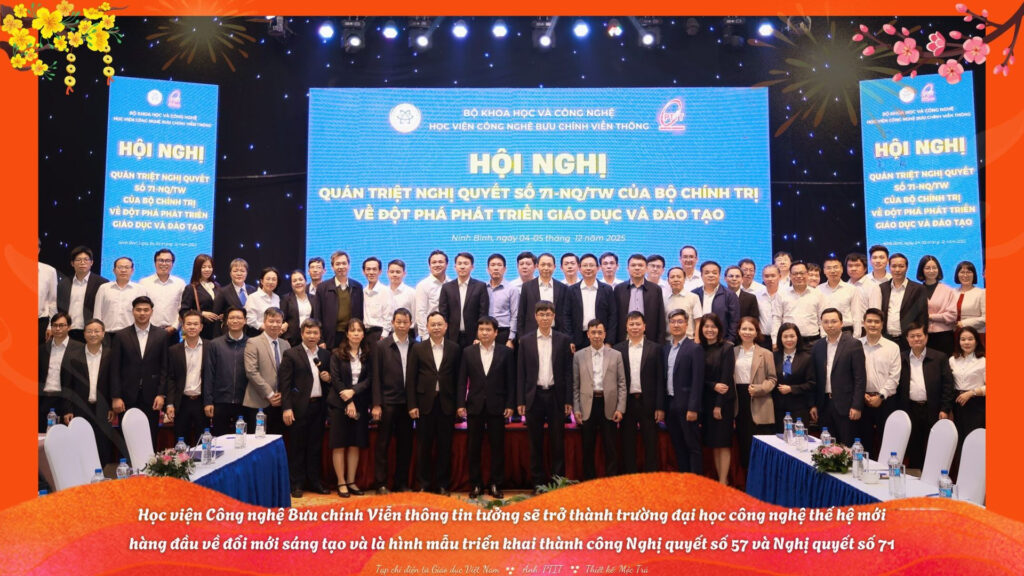
“With a series of synchronized solutions to rapidly transform knowledge and practice, Posts and Telecommunications Institute of Technology is confident it will become a leading next-generation technology university in innovation, and a role model for the successful implementation of Resolution No. 57 and Resolution No. 71,” expressed the President of Posts and Telecommunications Institute of Technology.
In August 2025, the Ministry of Education and Training announced the networks of centers of excellence and talent training for Industry 4.0 technology. Accordingly, the Next-Generation Network Technology, Intelligent Cybersecurity Technology, and Multimedia Communications networks are chaired by Posts and Telecommunications Institute of Technology.
According to the Development Plan of the networks for Next-Generation Network Technology, Intelligent Cybersecurity Technology, and Multimedia Communications, the Institute has identified comprehensive and specific solutions:
-
Regarding training and human resource development: The Institute aims to develop AI teaching assistants and excellent digital learning materials; implement specialized programs to train talented students and personnel; pilot a 40-30-30 training model (traditional – online – corporate/international); and build an online assessment platform integrating AI and blockchain for degree verification.
-
Regarding scientific research: The network will co-organize national-level scientific and technological tasks linked to doctoral training, prioritize prestigious international publications, and strengthen links with enterprises to commercialize products and promote creative startups.
-
Regarding international cooperation: The goal is to attract at least 100 global scientists and top experts to teach and conduct research in Vietnam; expand cooperation with universities in the world’s “top 100”; and proactively take on roles in major international organizations such as ITU, ASEAN-IVO, APT, etc.
-
Regarding facilities and infrastructure: Build a mechanism for sharing laboratories, multi-interactive communication complexes, and school radio stations; upgrade multimedia studios for digital content training; and propose investments to develop a synchronized, modern infrastructure.
According to the Vietnam Educational Electronic Magazine